Tuesday, January 17, 2017

Winter Spirit Week EC

Monday: Cuddle Me Monday


Tuesday: Twinter Tuesday


Thursday: Bring Your Own Blanket


Friday: Blue and Gold

Monday, December 12, 2016

Current Event #5: Energy

Article: "Signaling pathway cross talk in Alzheimer's disease"
Author(s): Juan A Godoy, Juvenal A Rios, Juan M Zolezzi, Nady Braidy, and Nibaldo C Inestrosa
Source: http://biosignaling.biomedcentral.com/articles/10.1186/1478-811X-12-23

Summary:
Alzheimer's disease is a debilitating neuro-degenerative disorder that destroys memory and other important mental functions due to the loss of cholinergic neurons. Studies suggest that the cause of Alzheimer's may be due to energy failure and intracellular waste. Energy demands and calcium fluctuation within neuronal synapses are essential towards neuronal communication. The mitochondria are vital in neuronal communication because they are high metabolic organelles that combine nutrient sensing and growth signaling pathways that decrease apoptosis, as well as regulate energy production and calcium homeostasis. Since the mitochondria is the powerhouse of the cell, troubles with it may cause the change in energy flow within neuronal synapses, which could alter neuronal communication. Dysfunctions in the mitochondria can result from reduced energy metabolism from the key enzymes involved oxidative phosphorylation, calcium imbalance, and reduced mitochondrial length causing abnormal dynamics. Ways to preserve mitochondrial function in Alzheimer's disease include increasing mitochondrial mass, promoting fusion fission balance, preventing excess calcium, preventing membrane swelling, and improving redox status. More sleep (melatonin) and caffeine treatments have been proven to restore mitochondrial dynamics and adding moderate exercise to daily routines also increases mitochondrial activity in the brain and prevents age-dependent mitochondrial decline.

How does it relate to class?
This article relates to class because we learned about cells and the functions of their organelles. One of the organelles was the mitochondria, which provides energy in order for the cell for function. For example, the Calvin Cycle occurs in the mitochondria, which converts sunlight into energy from plants. From this, we can see that the organelle is the main supplier for energy, and since energy is vital in neuronal communication, the mitochondria must function properly in order to allow for cell communication take place. If not, from what we learned through cell communication, the signal might never reach its target, the target could lose its signal, or too many signals are being produced, causing a disturbance in communication and alter the functions of the mitochondria.

What makes it cutting edge?
Alzheimer's disease has become a common topic with psychological diseases from books to movies. These discoveries may bring us closer to treating patients who have Alzheimer's and help them relieve their symptoms. It also shows how important energy is for our bodies, cells, and organelles.

 What is a big idea that you took away or that was reinforced?
One big idea that was reinforced in this article, was that energy supply is a necessity for neuronal communication. Especially with the mitochondria being the powerhouse of the cell, it is very crucial that the organelle maintains its normal functions in order to allow our cells to continue to grow healthy. A change in energy can change our mood, behavior, functions, and memory, this article shows how something that is provided for us endlessly through photosynthesis can affect our lives in many ways.

Why did you pick this article?
I picked this article because I always knew of Alzheimer's disease, however I never researched the causes or the symptoms of this disease. It is very interesting to see how the disease came to be and how problematic it can be to lack energy and calcium in our bodies. It is a great reminder for me to make sure that I maintain a healthy diet and always take care of my body in order to have a healthy mind and heart.

Wednesday, December 7, 2016

Current Event #4 for "Infection Secrets of Ebola Explained"

Article: "Infection Secrets of Ebola Explained" 
Author: Helen Branswell 
Source: https://www.scientificamerican.com/article/how-ebola-blindsides-the-bodys-defenses/

Summary
This article informs us on how the Ebola virus affects the human body. The ebola virus causes a fatal illness that causes severe bleeding, organ failure, and possibly death. When the virus enters the human body, it begins to disabling parts of the immune system by manipulating the white blood cells into attacking one another. With a weak immune system, the viruses can easily attack other cells in the body and spread the disease. 
The Ebola virus has a decoy strategy that tricks the immune system. It releases large amounts of secreted glycoprotein (sGP) into the bloodstream, which looks externally similar to GP. This tricks the immune system into focusing on fighting the sGP rather than the Ebola virus, making it think that the sGP is the main invader. This way, the Ebola virus has the advantage of attacking cells while the immune system is distracted.
Symptoms in the beginning of the Ebola virus include a low fever, as well as headaches, abdominal pain, vomiting, and diarrhea. Many patients are advised to drink a lot of water when diagnosed with Ebola in order to balance the fluid content in their bodies. Patients tend to have a profound loss of fluids due to vomiting and diarrhea, and staying hydrated can compensate for the loss of fluids from Ebola. Replenishing electrolytes, like potassium, can also relieve diarrhea for patients. 
Internal bleeding is another prominent symptom of Ebola. This is caused by disseminated intravascular coagulation in the damaged liver, which prevents blood from thickening in some locations of the body, creating leaky blood vessels. Since the virus is entered through the bloodstream, it causes more danger to the human body as it spreads throughout organs. 

How does it relate to this class?
The functions of the Ebola virus relate to what we learned in cell communication with the flight or fight response. The secreted glycoprotein releases a similar signal as the GP, which tricks the immune system to thinking that the GP is the main invader, while the Ebola virus manipulates through the body and attacks cells. The similar signal from the sGP activates a response from the immune system, so that it tracks the location of the sGP cells and fights it. We also learned briefly about how viruses can manipulate the body into attacking its own cells during class when we were discussing diseases.

What makes it cutting edge?
Ebola has caught attention by many scientists since it has spread throughout Africa. Many aspects of the virus has been unexplained due to its fatal symptoms, however, with research, we have discovered how the virus has been successful at attacking the human body. With this information, we are closer to reaching a way to cure the disease that has killed millions of patients through Africa and the rest of the world.

What is a big idea that you took away or was reinforced?  
The big idea that was reinforced in this article is the virus's ability to manipulate the immune system into attacking its own body. By secreting glycoproteins, the virus easily tricks the immune system into believing that there is another invader, besides the virus itself, in the body. By releasing a similar signal to real GP's, sGP's are able to trigger a response from the immune system, distracting it from noticing the real invader, the Ebola virus. 

Why did you pick this article?
I picked this article because I have known about Ebola since it became controversial throughout the news, however, I was not educated on the disease and how fatal it was. I thought it would be interesting to learn more about the virus, especially since it has killed and infected millions of people throughout the world, and has been such a threat that many people were detained from entering countries because of suspiciously having Ebola. It is interesting how fast the virus can spread and how detrimental it is to our health. 

Monday, September 26, 2016

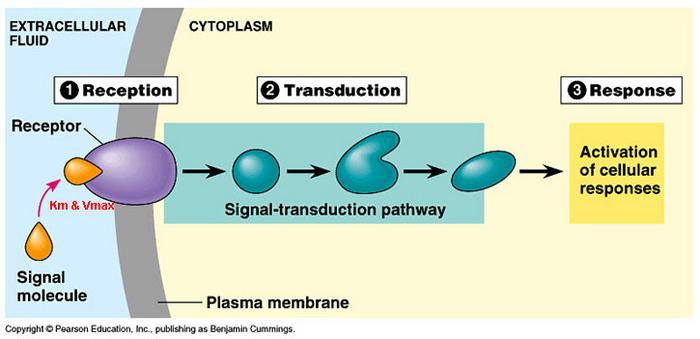
Basic Cell Communication Process

Image result for cell communication

Cell communication has 3 main steps: reception, transduction, and response. In reception, a signal molecule fits and binds into a receptor. The signal and receptor should fit like a lock and key. This creates a signal transduction pathway, where the relay molecules change their form in order to activate a cellular response. Once the molecules change their shape, a response is activated and trasmitted.
These steps could be seen through our activity on Friday based on cell communication. When the person playing the signal molecule touched another person on the activity, it created a chain reaction where people began changing their positions until the person at the end of the chain started running. The person running represented the response, before the signal molecule touched the receptor, the person was standing still with their eyes closed. This chain reaction represented the signal transduction pathway, in other words, form and function. Once the receptor activated, everyone changed their positions and began doing some other form of physical activity. This symbolized how molecules in the signal-transduction pathway have to change their form in order to change their function.

Sunday, September 25, 2016

Summary of "How Cells Communicate During Fight or Flight"

Through cell communication, cells in the nervous and endocrine systems prepare the body for a "fight or flight" response when a threat is present. Sensory nerve cells detect the threat or stress and send a signal from the site to the hypothalamus in the brain. Neurosecretory cells transmit a signal from the hypothalamus down into the pituitary gland releasing chemical messengers into the bloodstream. A nerve signal is also transmitted down the spinal cord, releasing a nerve impulse. The chemical messengers and nerve impulse travel down the adrenal gland, releasing signals. The adrenal glands then receive the signals and activate the release of endophrine into the bloodstream. The chemical messengers in the bloodstream begin a cell signaling cascade in the bloodstream to produce cortisol. Meanwhile, corticotrope cells in the pituitary gland are stimulate to release ACTH into the bloodstream. The ACTH cells arrive at the adrenal cortical cells and a signal is transmitted from the adrenal gland to the spinal cord. Signaling molecules in different areas work to provide a boost of energy. A signaling cascade produces glucose once epinephrine binds to receptors on liver cells. In addition, cortisol releases stored fatty acids to be converted into energy. These molecules are released into the bloodstream, supplying a boost of energy for the body to use. Epinephrine is an essential signaling messenger in the fight or flight response. The responses from epinephrine depend on which part of the body it is reacting to. When epinephrine binds to receptors on the bronchioles of the lungs, it causes the muscles in the lungs to relax in order to allow more oxygen into the blood. Epinephrine also can contract with muscle cells below the surface of the skin, to make hairs raise and sweat to form. The fight or flight response requires instantaneous messengers and physiologic changes in the body taking place. It prepares the body for extreme action or change and allows for an increase in circulation and energy to the body.

Summary of "When Cell Communication Goes Wrong"

The cells in our bodies are constantly sending and receiving signals. But what happens when cell communication goes wrong? Cell communication can go wrong when the cell loses its signal. The cells in our bodies release an insulin signal to our liver, fat, and muscle to store the sugars that we consume from the food we eat. However, in some cases, the insulin signal can be lost, causing the sugars to build up the toxic levels in our blood. Having too much sugar in our blood can lead to disorders like type 1 diabetes and possibly heart disease. There are also cases where the signal never reaches its target, causing a disturbance in cell communication. This can be seen in multiple sclerosis, a disease where the protective wrappings around the nerve cells and spinal cord of the cell are destroyed, preventing the signal from reaching its target. With the destroyed wrappings, nerve cells cannot transmit signals from one area of the brain to the other. A target can lose it's signal, which is demonstrated through the effects of type 1 and 2 diabetes. The cells of type 1 are unable to produce the insulin signal to their liver, fats, and muscles, while the cells of type 2 diabetes are unable to respond to insulin signals. These disabilities cause toxic levels from consumed sugars to build up in the blood, dangerously raising blood sugar levels in the body. There are also cases where too many signals are being produced. After a stroke, the dying brain cells release a lethal amount of signal molecules. These signal molecules are highly toxic to nearby brain cells and can cause brain damage. Cell growth and division require cell communication. However, cell communication can break down during these processes. When there is uncontrolled cell growth, cells lose their ability to respond to death signals, causing them to continue to multiple and grow. This causes the creation of cancer cells that uncontrollably divide to create tumors on the body. Overall, cell communication is an important process in the body that allows all organs to function and maintain health. When something goes wrong in cell communication, cells are respond differently or not respond at all, creating the build up of unwanted toxins in the body or spreading disease.